


Michelangelo’s David in the Galleria dell’Accademia, Florence
November 1, 2026
If you only see one statue on your trip to Italy, make it Michelangelo’s David in Florence. Hailed as a masterpiece from the moment it was unveiled in 1504 (“…to tell the truth, this work eclipsed all other statues both modern and ancient,” wrote the great art historian Giorgio Vasari), its reputation has only grown over the past 500 years.
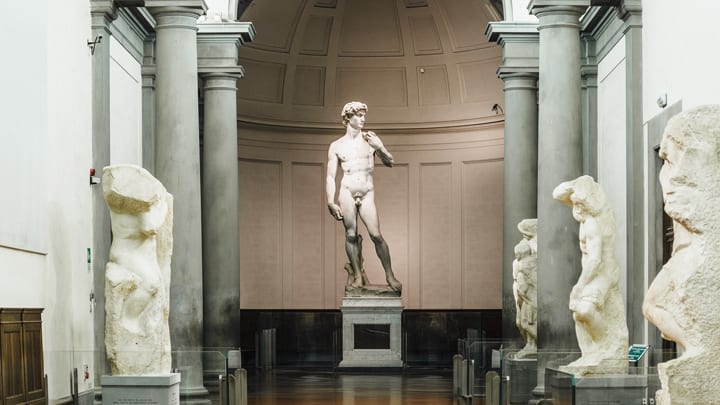
So, where is the statue of David in Florence? or, more precisely, what museum has the statue of David? Well, the easy answer to these common questions is that you’ll find Michelangelo’s original at the Galleria dell’Accademia, the museum that houses this statue, and other extraordinary Renaissance masterpieces. In fact, David is the centrepiece of one of Florence’s most famous art collections!
The iconic statue of David by Michelangelo, displayed in the Galleria dell’Accademia in Florence, surrounded by unfinished sculptures known as “The Prisoners,” showcasing the artistic genius of the Renaissance.
MIchelangelo´s David is a work that feels both strikingly familiar and overwhelmingly larger than life. It’s a statue you may have seen a thousand times in photographs, yet standing before it reveals details and artistry that no postcard or picture can do justice to.
Seeing the original in person is an experience that stays with you. To stand in the room at the Galleria dell’Accademia in Florence with this titanic marble – it’s almost 17 feet tall – is to experience humanity on the grandest possible scale and feel both dwarfed by it, yet strangely ennobled. There is nothing quite like it in the world of art. It may not the most emotional or even the most moving of Italy’s great marble sculptures but one could argue that it is the most awe inspiring.
All about Michelangelo’s David
The story of Michelangelo’s David begins with a mistake
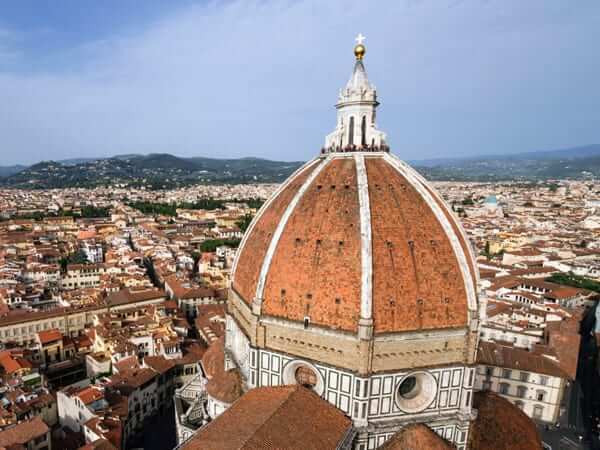
The story of Michelangelo’s David begins with a block of marble that had originally been earmarked for a statue to adorn the Florence Cathedral. Sculptors Agostino di Duccio and then Antonio Rossellino both worked on this slab of marble before abandoning their projects, and the giant block.
Decades later in 1501, the cathedral authorities decided to revive the project. They inspected the neglected block and sought a sculptor capable of completing an ambitious work. Michelangelo, who was then in Rome and had recently completed the Pietà for St Peter’s Basilica, returned to Florence to compete for the commission. At just 26, he was entrusted to take on the challenge.
The marble was particularly difficult to work with: it was tall, narrow and already deeply cut in places, leaving little room for error. Yet Michelangelo believed he could carve a complete figure from the existing stone, without adding any extra pieces. Unlike the earlier sculptors, he saw possibility where others had seen only problems.
The commission was awarded to Michelangelo on 16 August 1501, and he spent the next three years transforming the marble into one of the greatest sculptures of the Renaissance.
Leonardo da Vinci was among the prominent artists consulted in January 1504, to help decide where the almost completed statue should stand. And it was ultimately agreed to place David outside the Palazzo Vecchio rather than high up on Florence Cathedral, where its extraordinary beauty would have been much harder to appreciate.
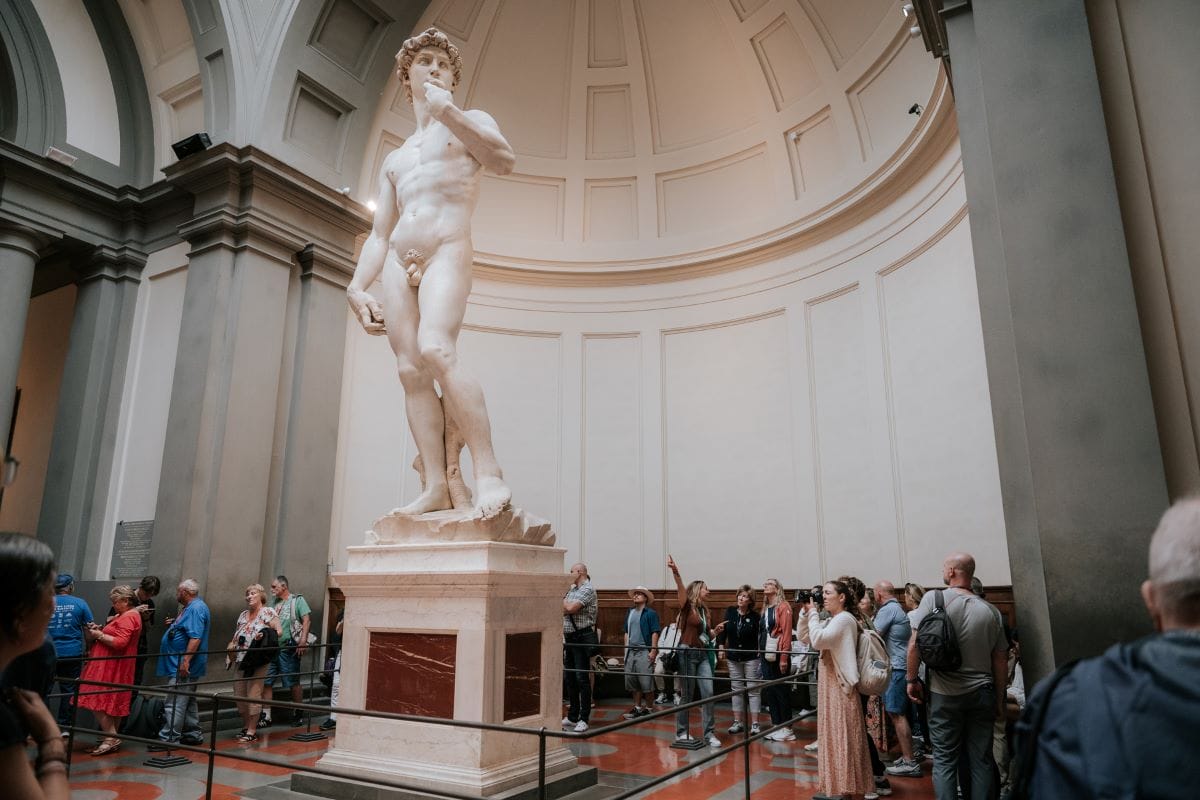
The statue towers above visitors and is a spectacle to behold!
Michelangelo’s David: A Masterpiece of Anticipation, Craftsmanship, and Enduring Legacy
Michelangelo worked on the statue in relative secrecy for three years. His choice of David – the biblical hero who slayed a giant with only his sling and a sharp sword – was a safe and well-established choice. Like many statues of David stretching back to the Ancient Greeks, he used a “contraposto” pose (weight on one foot, shoulders twisted off axis from the hips) to show intended movement. Unlike all the past Davids, he didn’t depict the hero in his moment of victory, but at the exact moment before he hurls a rock at the head of the waiting giant. It’s a moment of extreme pathos, almost cinematic in its scope – an entire story told in form, posture, and expression.
It’s unclear whether or not Michelangelo’s statue was originally intended for the roof of the cathedral. Certain elements, like the overly large head and hands, seem to indicate this. But when Michelangelo finished this colossal masterpiece, there was no question that it was going to have to stay firmly on the ground.
For many years it sat in Piazza della Signoria in Florence, with gold gilding covering David’s sling and the tree branch near his foot (which Michelangelo cleverly included to provide more structural support). However, in order to protect it from the elements, which eventually stripped it’s gilding, it was eventually moved into the Accademia where it can be seen today.
When you go, make sure to walk all the way around the statue. Notice how the expression differs from the side view that is on all the pictures to the straight-ahead view in which the real ferocity of David’s gaze becomes evident. Admire the musculature in the legs and the veins in the arms. Check out those immensely powerful hands! There really is no sculpture on earth quite like it so linger over it and enjoy a bonafide wonder of art.
Insider Tip: be the first one to get there! Skip the line with our VIP David & Duomo Tour with exclusive access.
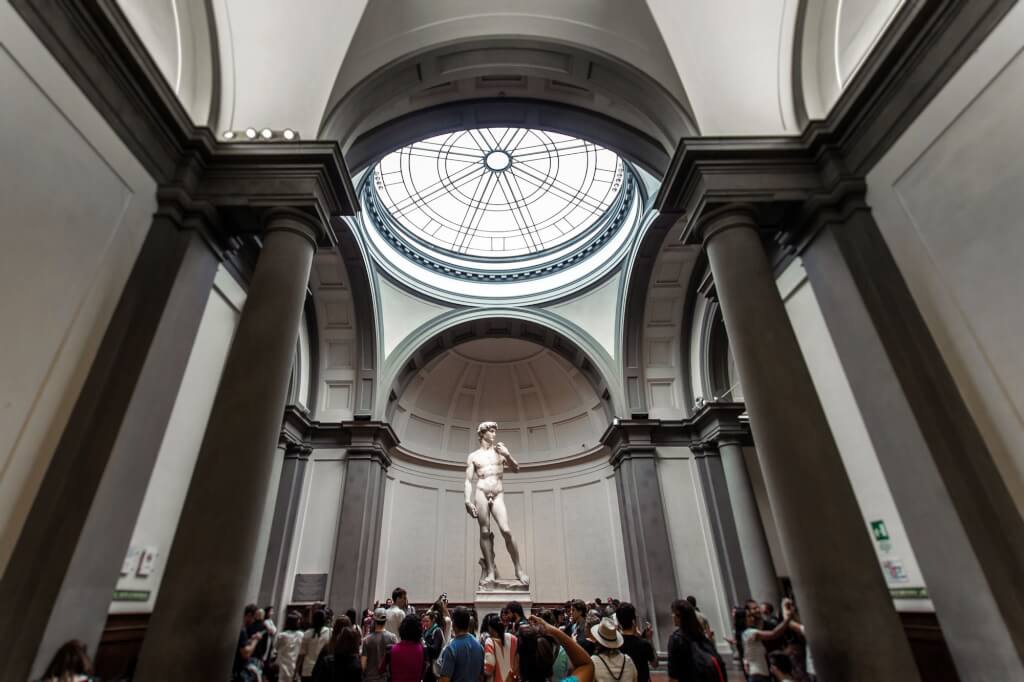
Many tourists from around the world visit Michelangelo’s David every day.
Tips for Visiting Michelangelo’s David
Opening Times
The Galleria dell’Accademia in Florence is open Tuesday through Sunday from 9.00am to 6:45pm, with the last admission 30 minutes before closure. On Saturday and Sunday, bookings are required.
The museum is closed every Monday, January 1, and December 25.
In order to accommodate visitors, the museum is usually open on holidays. However, if the holiday falls on a Monday it’s up to the board of directors to decide whether or not to open. Whatever they decide will be announced on their website.
Tickets
The Accademia offers three types of tickets: Full, Reduced, and Free.
Full (price) tickets are for any non-EU citizen 18 and over and any EU citizens 25 and over. There is no senior citizen discount.
Reduced tickets are available for EU citizens between 18 and 25 with an valid ID and public school teachers from within the EU with proof of their position.
Free entrance is given to anyone under 18 years old regardless of nationality with proper identification, people with certifiable physical disabilities who are accompanied by a family member, ICOM (International Council of Museum) Members, and Journalists with a valid ID showing professional status.
Please visit their website for the latest updates.
Rules
The museum is entirely wheelchair accessible, so unlike many of the most famous attractions in Italy, it’s easy to get around for those with impaired mobility. There is a strict no-photo policy in the Accademia. Even having a camera on your neck is grounds for a strong reprimand from the guards. Do yourself and fellow visitors a favor and just enjoy the art with your eyes.

Michelangelo’s David in the Galleria dell’Accademia, Florence- Best time to Visit
The Galleria dell’Accademia usually has a line out front and the later you go in the day the longer it gets. It isn’t as long as the line to climb Florence’s Duomo but it is long enough. There are two good ways to avoid it.
First, you can visit the museum with a guided tour with skip the line access. You can also book your own tickets online for a particular day and time. Be aware that tickets do sell out so book them as soon as you know your travel dates.
If you want to keep your itinerary loose the best option is show up outside the museum at least half an hour before it opens so you can be one of the first people in line to buy your ticket for that day. Please note that if you are planning to visit on Saturday or Sunday, booking is required.
Frequently Asked Questions
What is Michelangelo’s David?
Michelangelo’s David is a renowned Renaissance sculpture, celebrated for its detailed depiction of the Biblical hero and its representation of ideal human beauty and strength.
Where is Michelangelo’s David located?
The statue is permanently housed in the Galleria dell’Accademia in Florence, Italy, and attracts millions of visitors each year.
What is Michelangelo’s David history?
Created by Michelangelo between 1501 and 1504, the sculpture was commissioned as a symbol of Florentine freedom and quickly became an icon of Renaissance art.
How did Michelangelo sculpt David?
Michelangelo carved David from a single block of marble using innovative techniques that have influenced countless artists over the centuries.
Why is Michelangelo’s David so significant?
Beyond its aesthetic appeal and Michelangelo’s sculpture details, the art piece represents human ingenuity and the spirit of the Renaissance, standing as a testament to artistic mastery.
Can visitors see the original Michelangelo’s David today?
Yes, the original sculpture is on display at the Galleria dell’Accademia in Florence, offering visitors an authentic experience of Renaissance art.
Update notice: April 14, 2025

Book a Tour

Pristine Sistine - The Chapel at its Best
€89

1794 reviews

Premium Colosseum Tour with Roman Forum Palatine Hill
€56
850 reviews

Pasta-Making Class: Cook, Dine Drink Wine with a Local Chef
€64
121 reviews

Crypts, Bones Catacombs: Underground Tour of Rome
€69
401 reviews

VIP Doge's Palace Secret Passages Tour
€79
18 reviews

Legendary Venice: St. Mark's Basilica, Terrace Doge's Palace
€69
286 reviews
Follow us
Stay up to date with travel tips, local insights and all things Italy on our social channels!


Subscribe to our Newsletter
Get curated Italy travel tips delivered to your inbox!
