

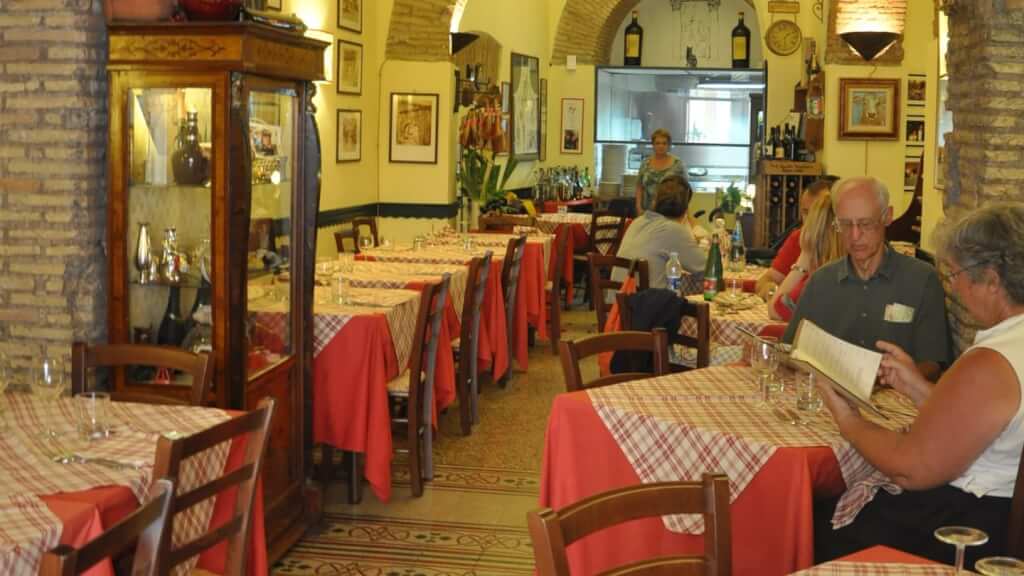
We’ve heard story upon story of tourists being ripped off at cafes or restaurants in Italy. We’ve even experienced it ourselves. And let us tell you: Unfortunately, nothing makes you leave even a great meal with a sour taste in your mouth like knowing you paid way too much for that tiny little coffee (8 euros? You must be kidding!)… or wondering if you did (when the waiter pointedly said “Service is not included,” were you really supposed to leave that 20% tip?).
These kinds of experiences can bring your whole trip to Italy down. And many tourists think that they’re just part of the deal when it comes to traveling in another country.
But let us tell you: They’re not. And, armed with just a little bit of knowledge, you can avoid being ripped off in Italy’s restaurants and cafes. Yes, even in the touristy areas.
From where to eat to avoid a fiasco to begin with, to the magic three words that will get any Italian to fix an overinflated bill, we’re going to let you in on some secrets that not even the locals want you to know. Take notes.
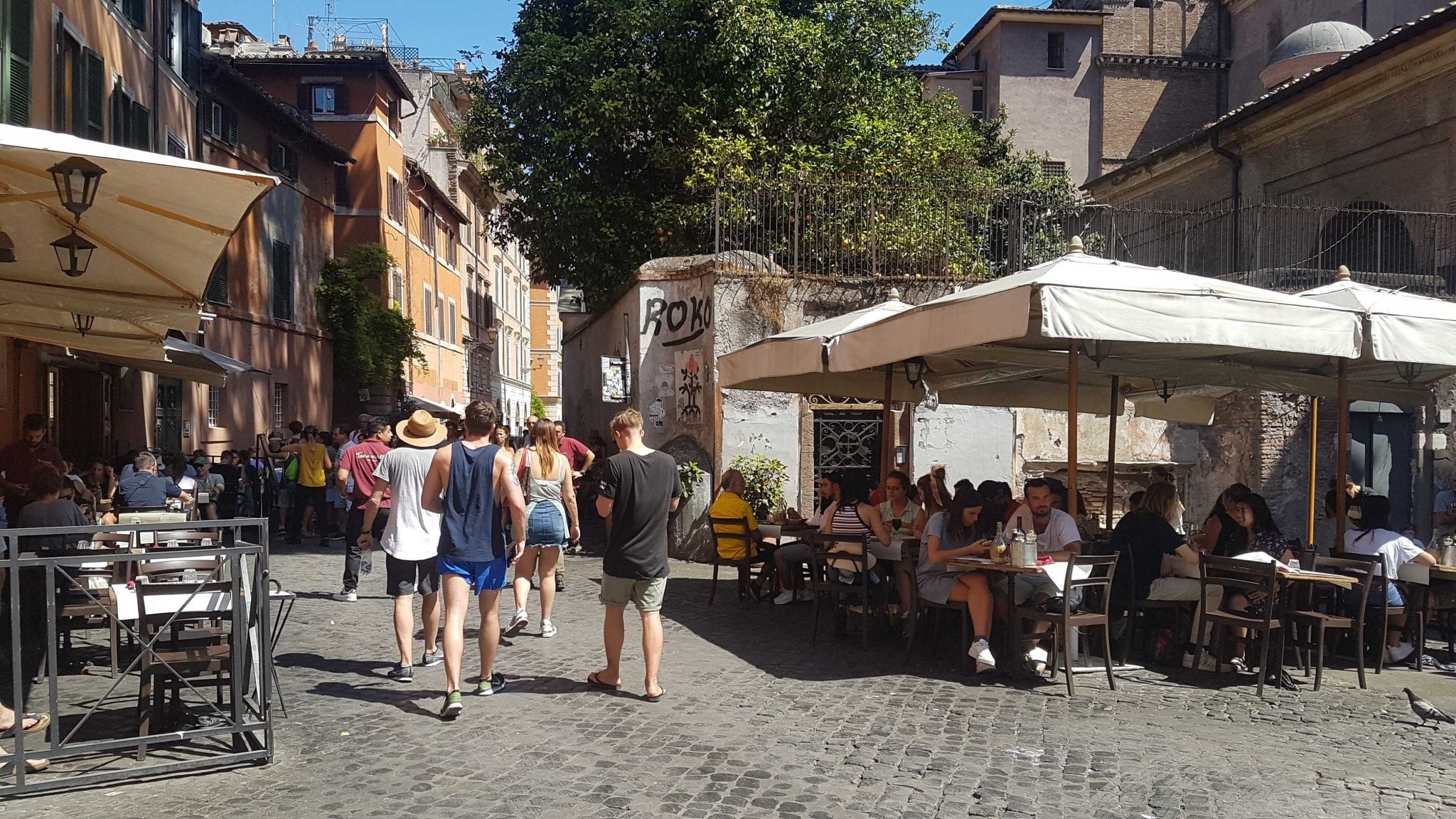
The farther away from a tourist site you eat, the less likely you are to be ripped off

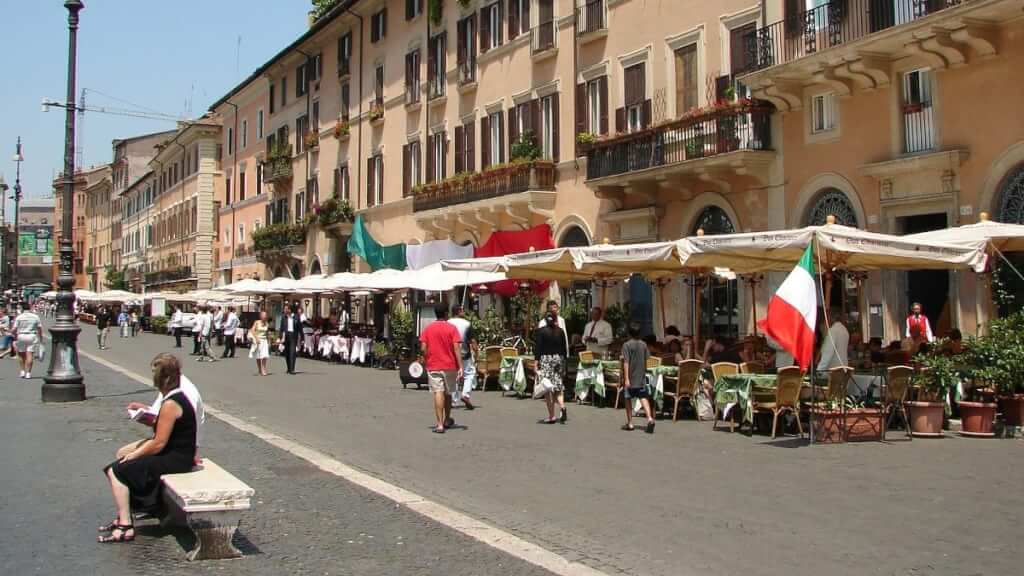
This view of Rome's Piazza Navona is lovely -- but eating at a restaurant while appreciating it will cost your wallet. And possibly your dignity.
It’s a sad truth that some Italians see Americans, Brits, Australians and others as easy prey. And so that’s why restaurants and cafes right near the big tourist sites are the most likely to try to take advantage of you. No, not all of them will. But trust us. It’s much more likely. After all, they’re used to busloads of tourists. They’re not as used to Italians or locals who know what a restaurant or cafe should and shouldn’t do… and call them on it.
For the record, yes, high-risk establishments include those on popular piazzas, like Rome’s Piazza Navona or Venice’s St. Mark’s Square. A rule of thumb: In general, whenever you see as many non-Italians as Italians, be on your guard.
Other tip-offs that you’re in a touristy establishment: There’s a “host” outside the door asking you to come in (any Italian restaurant catering to locals, not tourists, won’t have this, since they’ll be jam-packed with diners no matter what), there’s a menu with pictures, or there’s a big sign that says “Tourist Menu” or even “No service!” or “No cover charge!”. (More on that later).
That said? If you really want to avoid getting ripped off, the sad truth is that you have to have your wits about you no matter where you’re eating.
Don’t sit down in an Italian cafe. No, really. Don’t

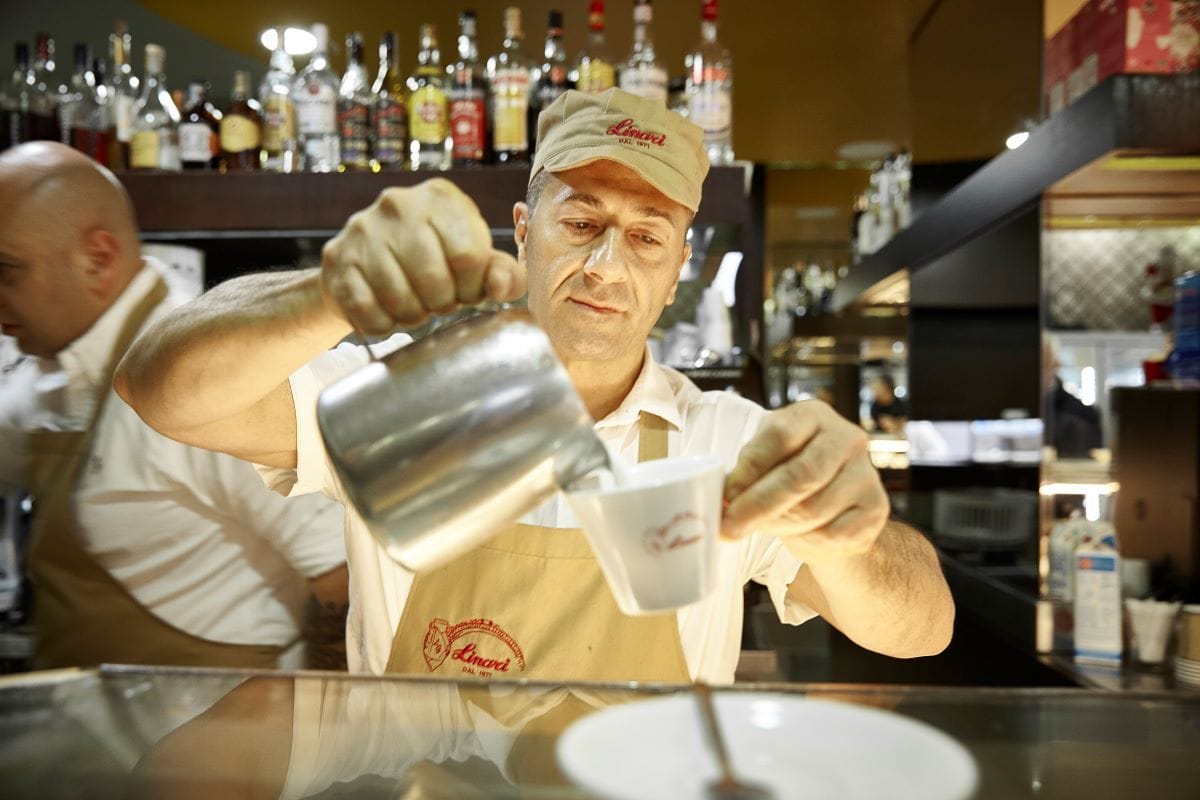
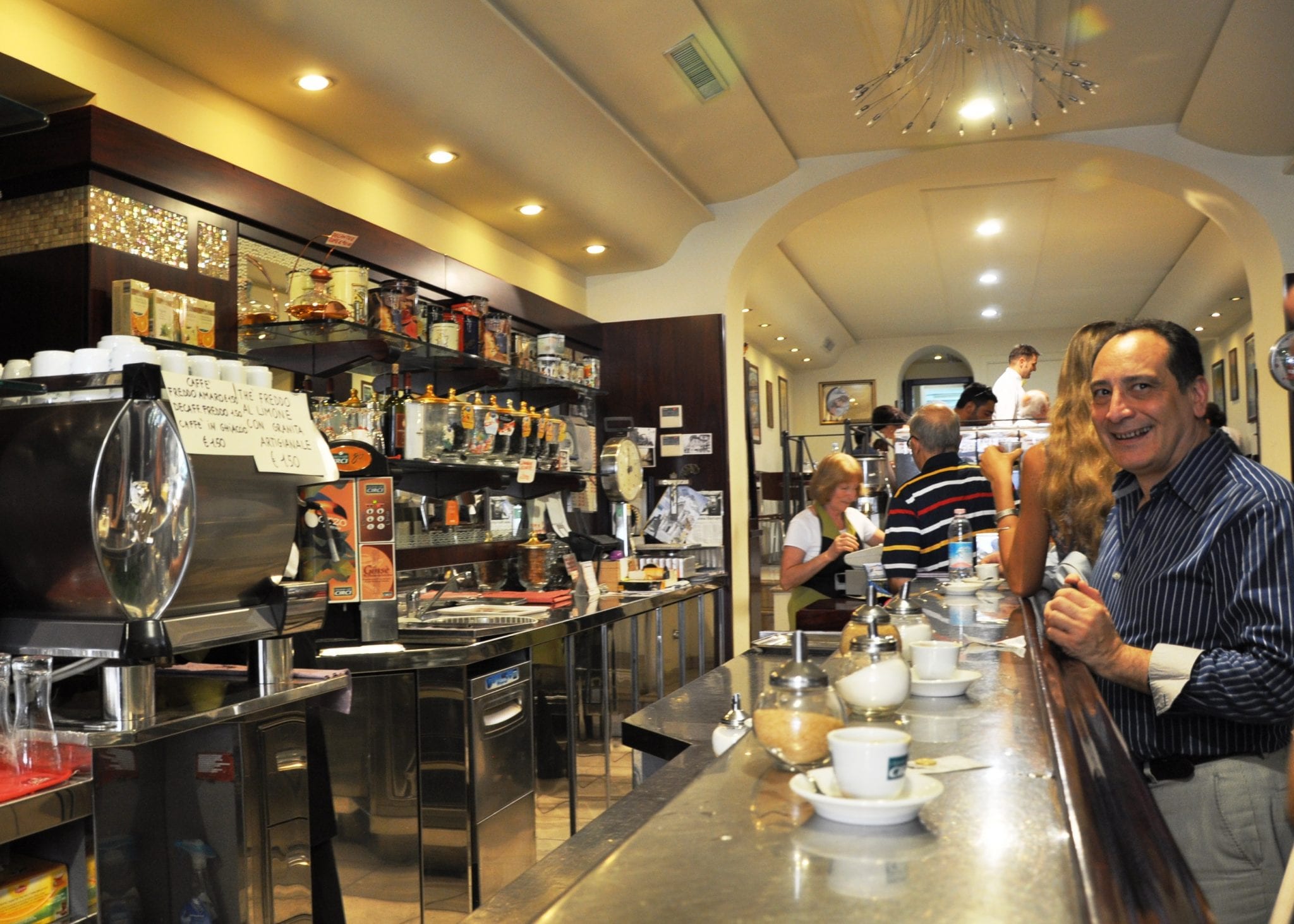
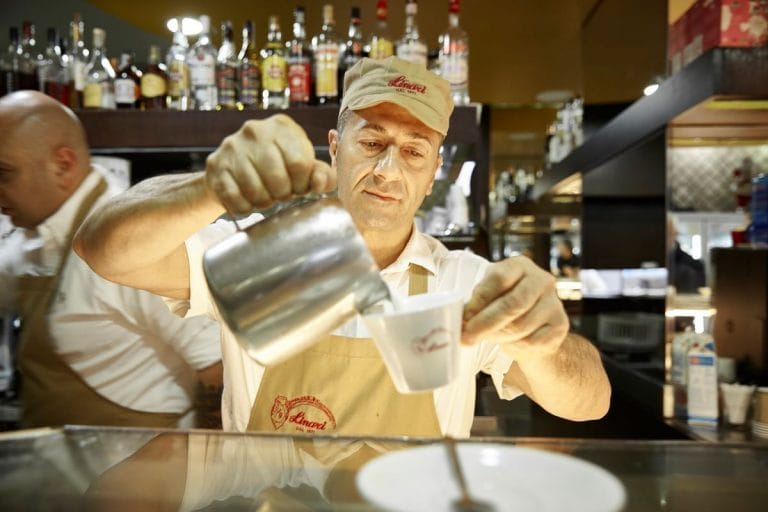
If you want to pay the prices that Italians pay for your coffee, then drink it like they do: standing at the bar
Unless your feet are just killing you, avoid sitting down in the kind of place that Italians call a “bar” and we call a “cafe.” Why? Because as soon as you sit down, the price of whatever you’re eating doubles, triples… or worse. That’s why you see Italians usually taking their coffee and cornetti standing up. Often, tourists will walk into a cafe and someone will immediately say, “Here, why don’t you sit?” It sounds like a suggestion, and a nice idea. And maybe it is.
But make no mistake: Even if it was their idea and you didn’t know there was a price difference, you’ll still be paying the sit-down price.
How not to get ripped off if you really have to sit down at a cafe

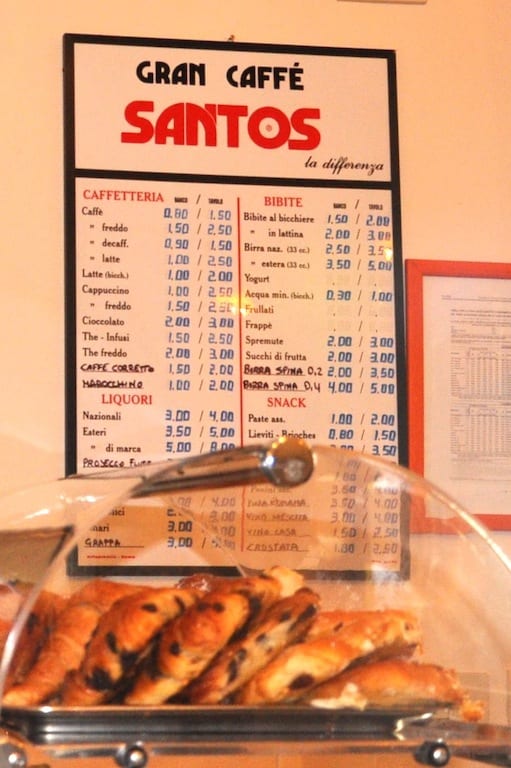
Here's the list of "Banco" versus "Tavolo" prices to look for. As you can see, they're fairly different!
If you do decide to sit down, before you order anything or make yourself comfortable at the table, always walk in and look at the prices above the counter. (These prices are almost always inside, above the bar, not outside… where more people would see them). Usually there is one column for “Banco” and one for “Tavolo.” “Banco” is the price if you stand at the bar; “Tavolo” is if you’re sitting. If it’s still worth it to you, then by all means, sit — but keep in mind roughly what those prices were.
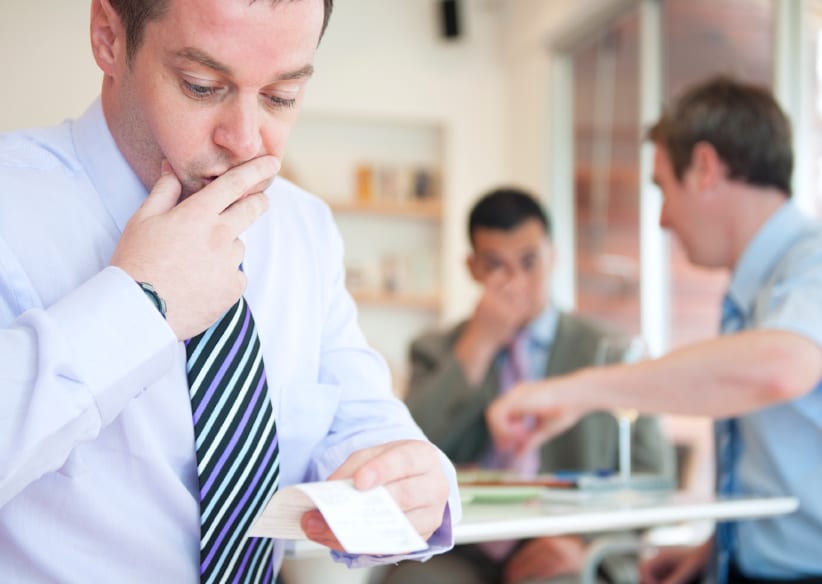
When you ask for the bill, ask for it to be itemized. (You can say “il conto dettagliato” ["eel cone-toe deh-tahl-yah-toe] or ““il conto lungo” ["eel cone-toe loon-go"). This minimizes the chance that someone will simply come up with a random price to charge you. If any of the items on the bill aren't what you ordered, or if the prices are different than what you saw on the price list inside, ask why. You know what the prices for the various items were supposed to be al tavolo, because they've been posted and, legally, that's what they have to be. Don't let the waiter talk you into anything different.
At restaurants, know what you do and don't have to pay for
Yes, you do have to pay for water. (You can ask for "acqua dal rubinetto," tap water, but it's often seen as a bit rude. Plus, those glasses of tap water will take ages to get refilled by your waiter, if they're refilled at all!). At moderately-priced places, a large bottle of mineral water for the table should cost no more than 2 euros, maybe 3 in more-expensive cities like Venice.
Yes, you do also have to pay for bread. This is the “pane e coperto” charge — more on what that is in a moment.
Yes, you do have to pay for that antipasto or foccacia. Even if the way the waiter asked you if you wanted it made it sound like it would be free. (“Would you like just a little bit of foccacia while you decide?”).
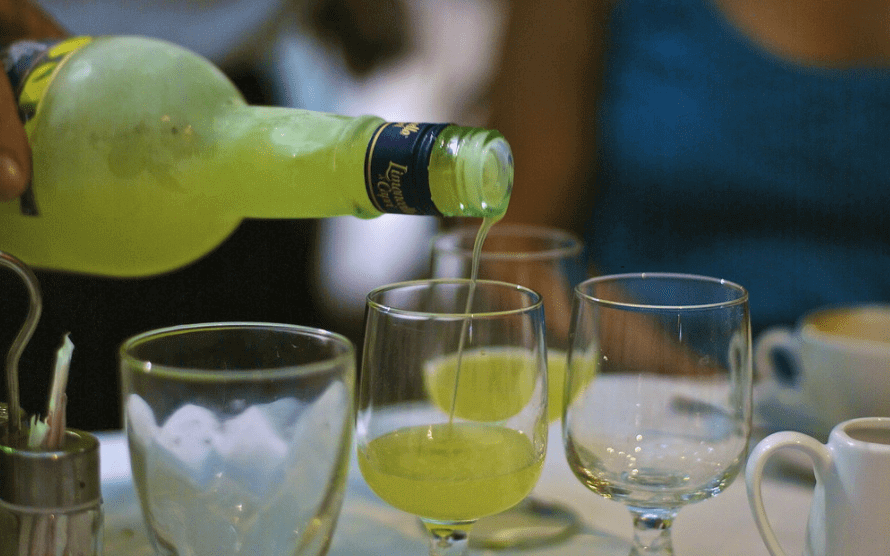
And yes, you have to pay for that digestivo of limoncello or amaro or grappa. Sometimes. Here’s how to tell: If the waiter asks you if you want an after-dinner drink after you’ve eaten but before he’s brought the bill, you’ll probably be charged. If he asks you if you want one after he’s brought the bill and/or you’ve paid, it’s probably a little “thank you” on the house. Needless to say, unless you’re a regular at a restaurant, the latter is the rarer situation.
Avoid giving the waiter the power over what, or how much, to bring
Sometimes, waiters will ask if you would like an antipasto for the table. Most of the time, this is fine. Occasionally, though, the antipasto winds up costing an arm and a leg — and you don’t realize it until you get the bill.

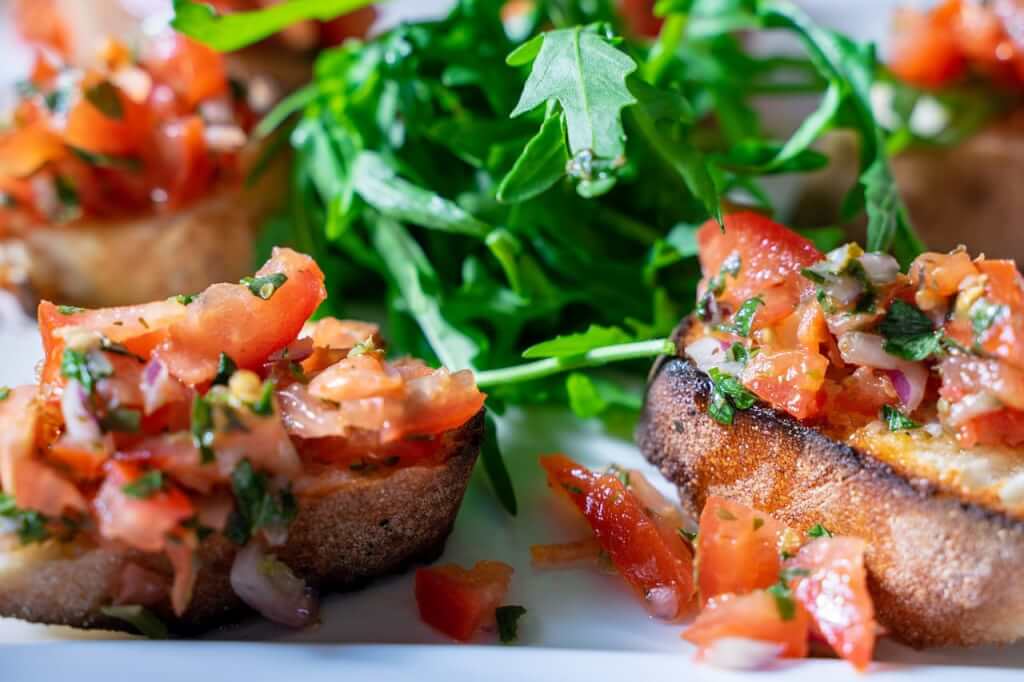
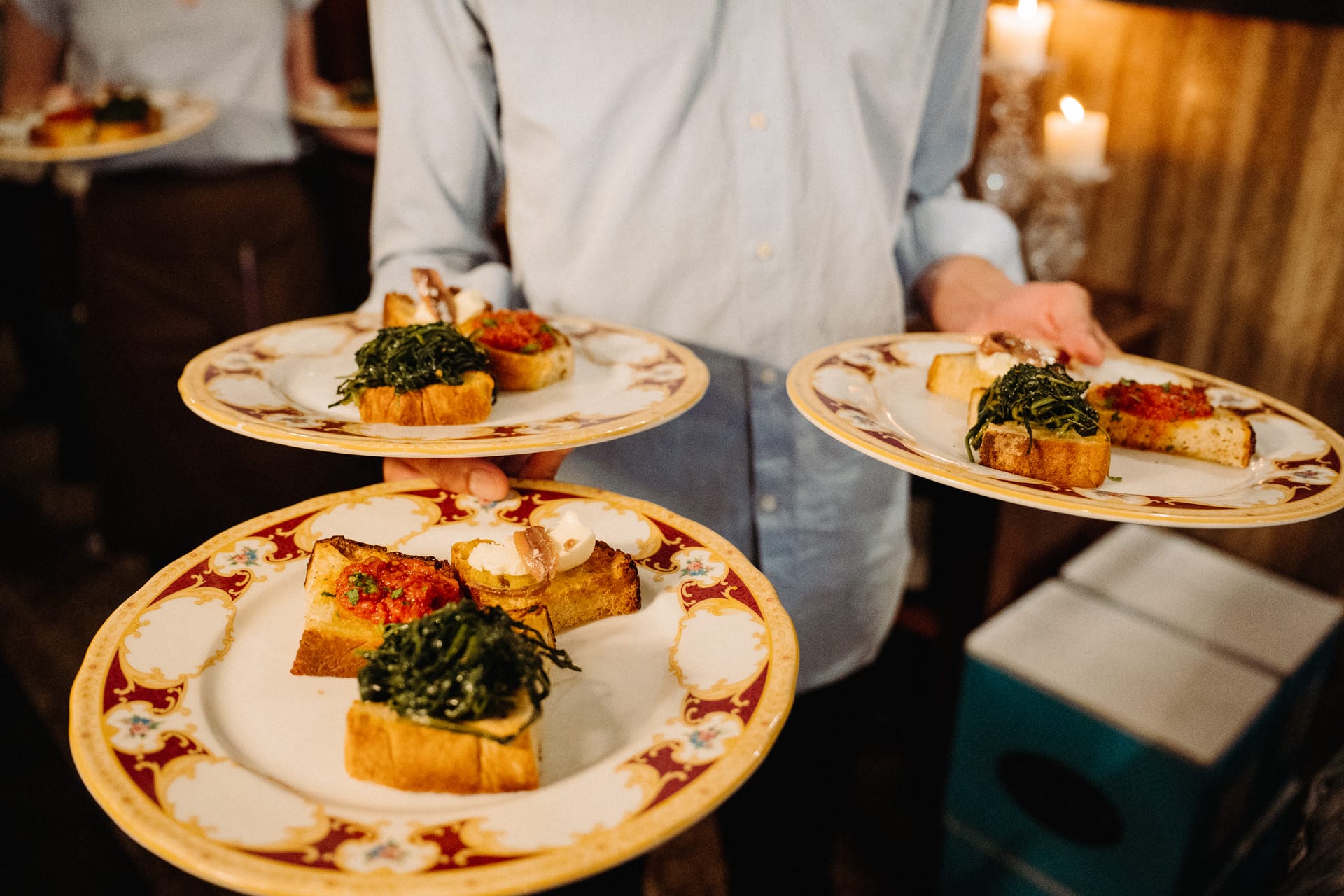
Be specific when you order an antipasto, or that bruschetta and other food might just keep coming and coming... at a cost
So instead of telling the waiter to just bring you something, order specifically from the menu, with the quantity you’d like, and be clear. “Vorrei un’antipasto per due,” you could say (an antipasto for two), even if there are four of you. That’s fine.
The other item to watch is fish. Since fish is usually charged by weight at restaurants, this can get a little confusing. You say you want the fish of the day that’s around a certain weight, the waiter brings out a lovely, fresh-caught one to show you that’s “around” that weight, and then miraculously, when the bill comes, it turns out that fish was a little heavier than you expected. Unfortunately, there’s not a lot you can do about this, other than to double-check the weight a few times with the waiter before you agree to have them cook it.
Getting the bill at a restaurant
When your waiter brings you a bill (remember, you have to ask for it!), make sure that it’s itemized. (Again, ask for “il conto dettagliato” or ““il conto lungo“). Sometimes, restaurants will just write a total number down, or even just say it. In that case, ask for the itemized bill. It’s the only way to know if you’re being charged what you should be. Plus, if you wind up being ripped off despite all your best efforts, it puts the power in your hands. We’ll tell you why in a little bit.
What’s that “pane e coperto” charge on my bill?
When an Italian restaurant charges you for bread, it’s generally not per basket. Instead, the price is usually per head. It’s typically about 1.50 euros per head, perhaps 2 or 2.50 in pricier, more-touristy places like Venice or Sorrento. That said, some regions have apparently passed laws, including Rome’s Lazio region, saying that this “pane e coperto” charge is against the law. That doesn’t mean that most restaurants are paying attention. And yes, most Italians are paying for pane e coperto as well — not just tourists. So in general, we let it go and pay.
But there’s a caveat. This charge should be written on the menu. Maybe it’s in small letters, maybe it’s on the back page, but it should be there. If it’s not? We make a fuss. And the charge gets taken off.
What about a charge for “servizio”?
If an item has been added, probably 10 but up to 20 percent, called “servizio,” that’s “service.” You see this often in Venice, the Cinque Terre, and Amalfi coast, and at more-touristy establishments in Florence and Rome. Something to know about servizio: Although it seems to be legal, it should be written on the menu, as should pane e coperto. (It’s often, of course, in small print and/or on a back page). Few Italians actually have to pay this servizio, and sometimes, it’s only written on the English version of the menu.
If the servizio hasn’t been written anywhere, ask for it to be taken off if you see it on your bill. If everything about the servizio seems to be as straightforward as possible — you knew, from the menu, it’d be 10% extra, and sure enough, it was — then pay it. But do not add a tip on top. That is the tip! Countless Americans wind up being double-charged on tips because they don’t realize this. And that’s exactly what these restaurants count on.
Note: Some restaurants try to attract tourists by saying, “No service charge!”. That’s fine… but it means the place is pretty touristy. (A place that catered to Italians probably wouldn’t have servizio, and wouldn’t make a big deal about not having it — especially not in English). And so, in general, since you have the least chance of being taken advantage of at non-touristy places, a sign proclaiming no servizio isn’t necessarily a good thing, either.
To tip your waiter… or not to tip your waiter?
First, one thing to keep in mind: Waiting tables in Italy is much different than waiting tables in the States. Many Italian waiters are paid off the books, meaning they’re not paying taxes. If they are on the books, then they get paid vacations (some six weeks per year or more) and paid sick leave. And they have national health.
Second: That tip probably doesn’t make it into your waiter’s pocket anyway. Often, it goes to the owner.
Furthermore, if servizio has been added to your bill (see above), then leave nothing on top. Rest assured knowing that, since most Italians won’t even have this servizio on their bill and won’t tip, you’re still tipping quite a lot in comparison.
So if all that’s been added to your bill is pane e coperto, or nothing at all, and your service has been good, then maybe leave something. But not 20 percent. Not 15 percent. Not necessarily even 10 percent. A few coins, or rounding up, is sufficient.
While that makes many Americans grimace, remember: Italy is a different culture. And it’s a different tipping culture, too. Adjusting to it is not only part of the experience, but shows respect for the locals.
Note: Often, a waiter might make the point of dropping a bill off to a table of tourists and, if servizio isn’t on the bill, saying, “Service is not included.” No, this is not his helpful way of clueing you into a local tradition. He would never, ever say anything like that to a table of Italians. Instead, he’s learned that those magic words get English speakers, especially Americans, to take out their wallets and leave an extra 20 percent… without realizing they don’t have to (and possibly shouldn’t).
Think you’ve been ripped off anyway and want to take action?
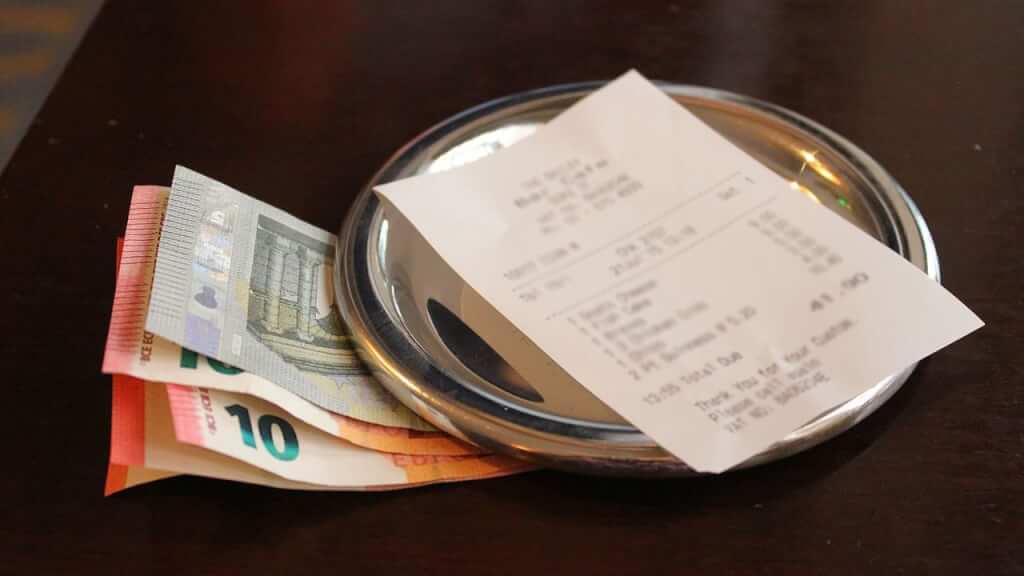
When presented with a confusing or ridiculous bill, 90 percent of people won’t do anything about it. They’ll pay and leave. But for the rest of the day, they’ll be seething — and it does a disservice to future tourists, since the restaurants learn that foreigners won’t speak up.
So remember: You do have control in this situation. Here’s what you do.
First, simply point out the discrepancy to the waiter and ask, politely but firmly, for it to be fixed. This is why you got that itemized bill. Even if he doesn’t speak much English, you can point to the specific item. For servizio or pane e coperto, the most useful phrase is often “Non è scritto sul menu” (this was not written on the menu – “Nohn ay skree-toe sool meh-noo”). Often, that’s all that’s needed.
If he argues with you, show that you know what you’re talking about (you saw the “banco” versus “tavolo” prices so you know what a cappuccino costs sitting down, etc.). He still won’t back down? Don’t give up. Here’s where you pull out all the stops.
If you’ve been ripped off and they won’t fix it, bring out the big guns
Your polite requests haven’t done anything to remove that 20 percent servizio that was added to your bill unannounced, or to get the proper tavolo price for your cafe meal instead of tacking on 20 euros more? You’ve still got power. In fact, a lot of power.
This is what restaurants, cafes and bars in Italy really, really, really don’t want you to know: A vast majority of the time, the receipt they’re issuing you is not a real receipt. That means they’re not paying taxes on the meal you just had. It’s off the books. And that’s illegal.
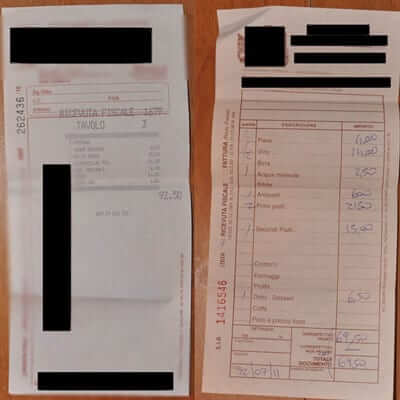
So, before you stomp off from the restaurant in a huff, look at the receipt you were given. If it looks like any of the following, it’s not a legal, fiscal receipt:

There's a legit-looking stamp on the top of this receipt with the restaurant's name, address, and even "partita IVA" number -- which we've blacked out to protect the not-so-innocent. Even so, this is not a legal receipt
And it goes without saying that what many find to be cute and Italian — like writing a number on the tablecloth — is absolutely, positively not legal.
Instead, here’s what a fiscal receipt looks like:
Often, by the way, what many visitors assume is the “real” receipt but isn’t is the preconto. Here’s what happens: The waiter brings you something that looks to you like a receipt, so you leave the cash and walk away. What you don’t realize is that the waiter is the one who’s supposed to take that first “receipt” and the cash, then bring back change and the proper (fiscal!) receipt. Some of what you see above were the “preconti”… but, even after bringing back change, the waiter never brought back the proper conto.
How does all of this give you the power? Because, if an establishment has taken advantage of you, it’s more than likely that you’re holding one of these illegal receipts in your hand. And in that case, here’s what you do.
Show them the receipt… and say the following three words:
“Guardia di finanza.” ["Gwahr-dee-yah dee feeh-nahn-zah."]
These three words are enough to scare any Italian business-owner. Why? The guardia is like Italy’s I.R.S. … with guns. They mean business. And they can do everything from levy huge fines to shut businesses down.
With those three magic words, your bill should be fixed. Quickly.
If you really had a horrible experience, of course, you can go one better: Say nothing, leave, and then hand the “receipt” over to the nearest guardia di finanza (shown above). They’ll probably be, erm, interested. And if enough people do this, then that restaurant will learn they can’t keep ripping off tourists… the hard way.


Anne Golembeski
/ July 30, 2011I lived in Italy for four years and have visited many times since but I didn’t know all the information given here!
Thanks!
Karen Fratti
/ July 31, 2011As an American trying to get by, I served lots of tables in lots of different places in Rome (super touristy trattorie on the via Lungaretta, a super fancy place tucked between via dei Coronari and the Lungotevere, and two off the map, local, restaurants in Prati and Pigneto).
While servers are off the books, we would get paid a set fee for our shift – the worst being 30 a day to the best, around 50 a day (like from 10-3, then 6-1am).
That said, you ARE supposed to tip your server, just not as much as you do in America. It would be normal for me to get 5-10 euro on a dinner check for two. The idea that the mancia goes directly to the owner, so don’t leave it, is silly and outdated. We worked long hours, off the books, 6 days a week and depended on those tips to pay our rent! 30-50 euro a day is nothing, really. Those old men in Piazza Navona get more, for sure, but when owners aren’t paying taxes, they can really rip off the waiters, especially the non-Italian ones.
walksofitaly
/ July 31, 2011Thanks for your comments, Karen! That you worked as a waitress while you were an expat here in Rome definitely provides an interesting perspective.
That said, though, it’s the rare Italian indeed we’ve ever encountered who leaves 10 euros on a dinner check for two (tourists, of course, often do exactly that). Not to mention that while 30-50 euros per shift can seem paltry to Americans, if you work 6 shifts/week, that’s 300 euros per week in your pocket, tax-free — so it seems a bit surprising to us that Italians would be “depending” on tip money on TOP of that to pay their rent. But let’s not forget that in big cities, many Italians live at home, so they get to save on rent in any case
Overall, though, we didn’t mean to write a post focusing on tipping or telling people never to leave tips. Instead, our aim was to tell people that there is no pressure to tip in Italy — and there absolutely isn’t, especially, as you say, in the American 15-20% range of things. Particularly if you’ve been ripped off!
bj norris
/ July 31, 2011When I visited Itlay (basicly my grand tour) my aunt told me the same thing but not all of what you have mentioned. It is sad that there that group of people doing that to the rest of the world. Also is sad that they are bringing that attitude to any country they are visiting or moving to. And the US is the melting pot for the rest of the world, it is our problem too. The statue of Liberty was given to us by France and France was the worst for service on my grand tour. I am in a tourist area too and the prices are high during that time and go down a little agfter the season is over. Granted they all work hard hopefully providing good service and also in taking advantage of the public.
This whole nation is in trouble rignt now, i feel it is because people only want for themselves and don’t care about the rest of the world. I am single, run my own business and still give people cost breaks and the best service possible.
Tip according to the service, if it is great, even with a little extra care, tip accordingly, if not, tip very little. The owner as well as the service people should appreciate it and all the business that comes to them because of it. Good decor, good service, good food and then change the good to excellent, i did a good or great job.Now you are always going to have the ones who don’t like anything and I ususally have 3 of those a year, then after it is a good year.
Bonnie
/ August 1, 2011Very interesting article. We visit Italy every year. Just had our 9th trip and did not know about the receipt legality. I do however dislike the title of the article. I have a hard enough time convincing people that visiting Italy is not like going to Mexico! They do not have to fear for their lives, of being robbed or mugged (or worse) or be on constant “rip off” alert. There is such a difference between visiting Rome or Florence and visiting a smaller town like Montalcino, but people don’t seem to change their outlook accordingly.
David in Abruzzo
/ August 1, 2011Really excellent article – complimenti !
In our part of Abruzzo there aren’t many tourists, so restaurants don’t overcharge (the 2-course lunch with wine/water/coffee for €10 is a reality) and tips aren’t expected.
In the big tourist centres, speaking Italian from the outset helps ward-off the worst excesses, but in general, a high percentage of tourists seem to be ripped-off (often without realising it)
Bonnie
/ August 1, 2011Another observation: many waiters in Italy, particularly in ristoranti, are hired under contract, so their pay is not “under the table”.
Nan @ LivingVenice
/ August 2, 2011I am sorry to read the the title of this article — it insinuates that rip-offs are the norm, which is simply not the case.
Is everything in New York a rip-off because it costs more? There are some good points made here, but really, there is no need to make people paranoid with a inflammatory title like that.
On the plus side? Tomatoes actually taste like tomatoes…what a concept.
walksofitaly
/ August 2, 2011Hi Nan,
You’re right — it’s absolutely unfortunate that we had to title this post this way. But it’s not about things “costing more” simply because you’re in a city or tourist area, as you would in NYC; it’s about tourists often getting completely different, and inflated, prices than the locals — illegally, and without accompanying higher quality of service or food. (In fact, touristy restaurants often serve some of the worst meals you could possibly have… where tomatoes aren’t really even tomatoes!
). We don’t think anyone who’s lived in Italy for any amount of time could disagree with the fact that this does happen, and often. This post was a guide to how to deal with that.
And yes, if you’ve made the waiter “jump through hoops,” then absolutely feel free to leave something as a tip. We’re just saying that 20% as a matter of course, no matter what the service is like, is completely unnecessary! Handing it to the waiter is a great suggestion — that way you avoid the whole it-going-to-the-owner problem.
Thanks for your comments!
Nan @ LivingVenice
/ August 2, 2011p.s. I think travelers should almost always tip the waiter – as foreigners we make them jump through so many hoops that a regular Italian diner hardly ever does. If you’ve been a bit fussy, leave ‘em 5% – 10% — cash — and make sure you hand it to them!
Antonio Iabichino
/ August 2, 2011As Italian and as wedding planner, so I’m involved in the tourist sector let me say that this is quite interesting article and unfortunately it’s way much true BUT there is one thing I do not agree at all and is when the writer states: “we’re going to let you in on some secrets that not even the locals want you to know”. I TOTALLY disagree with this point of view that makes us seen as we would like to trick people all the time! This is not true, as all the things that are said are things we face as locals in our daily life as well. Honestly we do face the same things many times but I thank the author for this article because this will help wrong things change change and will make possible to give better services.
walksofitaly
/ August 8, 2011Hi Antonio,
That’s an interesting perspective, and you’re right — we shouldn’t have made it sound as if many, many Italians aren’t annoyed or even furious about the same shenanigans that tourists are! You guys sometimes get the brunt of it, too
(although I think foreigners who don’t speak Italian and don’t know what to expect are perhaps a little easier to trick). Thanks for this reminder, and thanks for your support for the article. We, too, hope these things will change!
Antonio Iabichino
/ August 2, 2011Un interessantissimo articolo che secondo me getta una traccia sul perché negli ultimi anni siamo passati ad essere dal 3º paese più visitato al mondo al 5º, superati ormai dalla Spagna e dalla Cina.
Al primo posto c’è sempre la Francia!
Segno del nostro declino economico e culturale.
walksofitaly
/ August 8, 2011For those who don’t speak Italian, the translation:
“An interesting article that, according to me, is on track, because in recent years we have gone to being the 3rd-most visited country in the world to the 5th — now surpassed by Spain and China. In first place, it’s always France!
It’s a sign of our economic and cultural decline.”
Thanks for your comment — we always love getting an Italian’s perspective!
Ismail Daif
/ August 4, 2011After visiting cities in Lombardy, Veneto, Tuscany, Lazio & Sicily I’m happy to say I have only been ripped off once, in Pisa. Possibly because I’m not an English speaker.. or because I don’t fancy touristy restaurants.
Anyway, thanks for the info! At least I’m armed for upcoming rip-off situations
Btw, I don’t understand why they would use ricevuta “non fiscale” instead of printing “ricevuta fiscale” if they’re cheating anyway?
Igor Manzoni
/ August 11, 2011Hi Ismail,
they give you the “ricevuta non fiscale” in order to evade taxes by not adding the amount on the registers. But if they will put “ricevuta fiscale” on the ticket the “Guardia di Finanza” could check the registers and by not finding the corresponding amount it would be a worst situation for them than simply say it was a misunderstanding. Many of this “Italians” know very well what a poker face is.
Igor. (from Milan)
MdAmor
/ August 4, 2011I haven’t had any problems eating in Italy, but the pickpockets were everywhere! Thanks for the great info.
Gayle
/ August 4, 2011Fantastic advice – and great detail, too!
rulol
/ August 4, 2011As a tourist operator and an italian citizen i would say it’s quite outrageous to depict the operators as a bunch of blackmailers or thieves : i would like to remember that Italy is a fascinating and complex part of the world hard to understand for non-italians who too much soon try to judge and pretend to catch what’s going on here.
Thieves and rippers are everywhere in the world (incl. USA) : maybe it’s time for the travellers to become more informed and smarter and it’s time for the travellers to try to understand and learn about the society, the habits, the locals’ attitudes they are going to visit maybe also trying to learn some words of the native language : not everywhere english language has to rule the world…
Guest
/ August 26, 2011rulol, you wrote: “maybe it’s time for the travellers to become more informed and smarter and it’s time for the travellers to try to understand and learn about the society, the habits, the locals’ attitudes they are going to visit ”
This article you’re so strongly criticizing is exactly that; trying to learn and become more informed about another culture. What’s wrong with that?
Rita
/ October 8, 2011Unrapalleeld accuracy, unequivocal clarity, and undeniable importance!
Marco
/ August 4, 2011i’m italian and i travel a lot in my country.
unfortunately sometimes (somentimes!) in the mayor roads of the mayor cityes happens that owners try to rip off strangers.
i think the best way to don’t be cheated is just to watch the menu and make mentally the bill before. when, at the end, the ceck comes ask why if is different.
and the tip? all goes to the owner… ahahah… what is italy? a slave country?
or: six or more weeks of vacation, c’mon!
and, yes, we have national health care. we pay for it, i dont know why you relate it to the tip.
ok, i stop, it starts to be boring
Icovada
/ August 4, 2011As an Italian, I would like to point out that not all receipts have to look like the ones you said are right.
Most of the times the restaurant will just have a “registratore di cassa” and give you a white strip of thermal paper, just like the first one in the article, that does NOT say NON FISCALE.
Those are legit. Don’t make a fuss if they give you one.
Besides, I just loved the “Like the I.R.S… with guns”. So true.
Polizia? Kinda scary
Carabinieri? You sometimes forget how to walk casually when you’re around them.
Guardia di finanza? It’s maybe better to walk all the way around the block.
Mauro Acquati
/ August 5, 2011Dear all,
I’m Italian and working in the Travel Industry. I find this article pushed too far on bad habits and chances to be ripped-off. I had the bad luck to be ripped-off sometimes in all parts of the world. It happens evrywhere, that’s it. Italy is nothing worse or better than other places. So, please, don’t make this unique Country look like a criminal ambush for Tourists. Congratulations for the blogin general, well done and useful.
Mauro
walksofitaly
/ August 8, 2011Thanks for your comment, Mauro! I’m sorry you thought we were making this country look like a “criminal ambush” — as you can see from our blog and our company, that is certainly not our intention. However, this particular post was about how not to get ripped off while eating in Italy… so that’s what it was about! We’re not saying that getting ripped off happens more or less in Italy than in other countries, but our company and blog is about Italy, so Italy is what we write about.
Thanks again for your comment!
Joe
/ August 5, 2011I have been to many cities in Italy and what you say has been the case for me in many resturants. I appreciate the article and it will save me alot of anguish in dealing with this situation in the future. Maybe you can figure out the taxi situation for another article. It’s also a problem.
walksofitaly
/ August 8, 2011I’m glad we could help, Joe. And you’re certainly not alone — we can’t tell you how many clients and visitors we’ve had to Italy who have experienced the exact same thing! We hope this post can help everyone
. Oh, and we’ve actually already written about how to handle the “taxi situation” in Italy. Now you can return to Italy with all the tools you need
. Enjoy your next trip!
Sabbry
/ August 6, 2011Italians stand at bar because they usually have cornetto and coffee during the coffee break!!!! Italians usually seat in late afternoon or evening!!! so if u are sitting in the morning or in the afternoon, then u are a tourist!!!! The reason why the price “al tavolo” is higher, is very simple. The property has to pay a lot to have tables and chairs in the road in the city center, so if u want to seat there u have to pay more!!! But I think to have a coffee seating in piazza navona or piazza San Marco has really NO PRICE!!! So, please, just seat, enjoy your coffee, enjoy the wonderful view and pay your bill!!!!!
Igor Manzoni
/ August 11, 2011Sabbry,
I’m Italian too but for me, 7 euros for a coffee it’s quite a huge price! Try to mind the fact that coffee is one of the more profitable products in a bar. It’s so with it’s normal price too! (More or less 1€)
Luca
/ August 8, 2011Just a suggestion from an italian guy living in France. When you got to a bar or restaurant avoid touristic areas to sit it is more expensive in Rome as in Paris as in London. Find good place on guide or ask to people around you, even the nice girl in the museum will suggest you how to avoid to be cheated. DO NOT go where you hear just english or french or russian or whatever you will not enjoy your mean, sit where you hear a lot of Italians. By the law the price must be specified on menus also for the service and the “coperto” so if you do not see the price in the menu, do not go! Another thing just to know: a good restaurant have no more than 5/6 “primi” and 5/6 “secondi” this means that when you can to choose between 12513 different dishes something wrong is happening there.
Do not accept piece of paper as a Bill unless you are going in a very little typical “trattoria” where the owner is an old man with mustaches but your bill will be no more than 15€/person
.
By the way this article is scaring people wants to visit Italy. The same kind of things happen in France, England, and Spain so c’mon guys cheater are everywhere. Continue to go in Italy you will not regret
walksofitaly
/ August 8, 2011Thanks for your comment, Luc! Those are also some excellent tips. As for your last point, we certainly didn’t mean to scare anyone who wants to visit Italy — as is clear from our blog, and our company, we LOVE Italy! It’s just a heads-up to first-time visitors who may be, and who we KNOW often are, caught unawares by these kinds of shenanigans.
And yes, as others have noted, these things can happen anywhere — but our blog is about ITALY. Therefore, we’re going to try to prepare travelers for what can happen to them while they’re… in Italy! (We’d love to read someone’s post about how to avoid these types of issues in other countries, too, though!).
Thanks again for stopping by, and for your comment!
trudy
/ August 11, 2011I appreciate your advice – we are planning our first trip in a couple of days – I think some people are taking your bewares, a little literal, and I don’t think that’s how it was intended. It’s unfortunate that these types of ‘rip-off artists’ exist, but they are everywhere, I think you have jut helped to point out, the different methods, and I appreciate that. I don’t anticipate we will get gouged, but one can never tell – even in our own city – so it’s good to get the heads up – knowledge is power in the event where you might have to use it.
Thanks again
atrongreg
/ August 14, 2011I would like to say I appreciate this information. I still love Italy and can’t wait to honeymoon all over your country. I agree with Trudy that it was taken quite literally by some people. PEOPLE: there is no need to get defensive. The article was not bashing Italy in any way. It is simply something that does occur in Italy. But for those of us who are visiting for the first time, we would like to know how to reduce our chances of getting taken advantage of. I would do the same for anyone coming to the US for the first time–like what places and people to avoid. This doesn’t mean I don’t love my country!! Thanks.
Sara
/ August 27, 2011I am a frequent traveler. I lived in France and the USA the past 32 years of my life. Italy is a beautiful country and that’s the reason I spent my 3 last summer vacations in Italy, traveling from Milan, to Florence, to Rome and most cities in Sicily. I found it very upsetting that most resaurants I have been to in Italy give you a fake receipt, prefer cash payments, pretend that their credit card machine is out of order. I just finished my dinner at a restaurant in Syracusa, and paid 25% extra for bread and service. Prices are written in small letters.
In France, restaurants do not rip off tourists. We should really compare Italy with France and not Mexico!
Mimosa
/ October 7, 2011Appreciation for this infmrotaion is over 9000thank you!
Alissa
/ September 16, 2011What do you do if you get one of the fake receipts? Do you just ask for il conto fiscal? And how do you know when you have the real thing? Is it the numbers on the side?
walksofitaly
/ September 16, 2011Hi Alissa,
You’ll probably get the fake receipts much more often than not, especially in central and southern Italy, if you’re paying with cash. (A credit card transaction has to be registered). Because it happens so often, we’d use saying something about the receipt as a last resort only if you think the restaurant is taking advantage of you in another way. But, of course, you’re entitled to always ask for a legal receipt if you want, regardless of how the place treated you! You would ask for “una ricevuta fiscale,” meaning “fiscal receipt.”
Admittedly, it can be a little tricky to tell if a receipt is fake or not. But for it to be real, it should have all of the following:
It should say “ricevuta fiscale” on it, and that option should be checked. It should also have the restaurant’s 11-digit partita IVA number, which is their tax identification number (we’ve blacked this out in the examples for privacy reasons). And it should have the restaurant’s name, the restaurant’s address, the date, and a full list of what you ate.
We hope that helps! Thanks so much for your comment and for stopping by.
Justine
/ October 17, 2011Been living in Milan for 2 years and will be taking a trip down to Florence. I’m looking forward to revisiting Il Latini, a place known for their fiorentine steaks and their rip-off prices. They look at your table, scribble something, smile, nod and give you a check for triple the amount its worth.
Last time I went, I couldn’t enjoy my steak because I was too worried about getting a huge bill and not being able to do ANYTHING about it. Even though a little nervous, I’m prepared to go in to ask for an itemized bill and if necessary… I’m pulling out that beautiful 3 word phrase. Thanks Walks of Italy!
walksofitaly
/ October 21, 2011And thanks for reading Justine! Next time you’re in Rome give us a shout and we can have stop by a restaurant that doesn’t pull this kind of stuff.

Stay in touch and keep reading, we read your blog, too! And keep your eye out for Walks of Italy Milan, we’ll be working up there as well from next year. Ciao!
Justine
/ November 2, 2011Awesome! Congrats on the expansion! If you’re looking for bloggers/additions to your team in Milan, keep me in mind! Looking forward to meeting you on my next trip to Rome =)
PS: I found this guy waiting for some of your readers to visit in Venice
http://littlemisslocal.com/2011/11/02/local-venice/
Diana F
/ October 30, 2011Thanks so much for you tips! I was recently in Italy and I was already sort of aware of it but they always find a way. Tourists are easy target for them. I am writing a post regarding my trip and I’m glad to share your tips. I will share the link.
Thanks,
Diana
Melan
/ January 11, 2012I think people are missing the point of this article. It isn’t about frightening people away from Italy or suggesting that all Italians are cheats and thieves, it is about being more aware of some of the practices of some of the owners of places where tourists eat. I live in Italy for 15 months, in both Rome and Florence, and I was ripped off many times before I realised what was going on. My tip is never, never eat near a tourist destination or where they have a tourist menu.
walksofitaly
/ January 19, 2012Very good advice, Melanie! Thank you for stopping by and for the kind words. And we completely agree—Italians certainly aren’t all cheats and thieves, nor would we ever want to frighten people away from Italy. We just want to make sure that people have the most knowledge possible to make their trip the BEST it can be!
Mansi
/ January 18, 2012Hahaha..i never knew all this before. I always imagined Italian cafes to be quite affordable for a cup of coffee and a piece of bread. But it’s strange that cafes are quite expensive there.
Jerry
/ February 7, 2012Excellent post. We are headed to Cinque Terre – visiting it in the off-season. Are we more or less likely to get ripped off during low season? Or doesn’t it matter? Also, could you give a brief explanation of the price differences that might be expected between cafes, trattorias, osterias and ristorantes? Any differences in the kinds of bills we should expect between one type of eating establishment and another? Thanks!
walksofitaly
/ February 9, 2012Hi Jerry,
We’re glad to hear that you’re visiting the Cinque Terre! With the bad press from the floods that happened there this fall, they can use the tourism dollars now more than ever.
As for your question about low vs. high season, when you’re more likely to get “ripped off” is hard to say. If, for example, a waiter is going to try to take advantage of you by charging you for something that you didn’t order—the kind of thing which does sometimes happen, but that is certainly not the norm and that you shouldn’t feel paranoid about—that’s someone who would probably try to take advantage of you regardless of the season. So, regardless of the season, be open, be friendly, enjoy the area and the people—just simply also be aware, i.e. double-checking your bill and following other tips that we outline in this post.
As for price differences between different eating establishments, there used to be a big difference in price and atmosphere from a trattoria to osteria to ristorante and so on. However, these differences have largely diminished (although a “ristorante” does tend to be on the more elegant side). In general, if you’re on a budget and what to find the best-value food, just make sure to 1) get recommendations about where to eat, preferably from a local you can trust and/or by doing some online research before you go (this is particularly helpful in touristy areas like the Cinque Terre), and 2) look at the menu before you walk in. Most trattorias, osterias and restaurants will have one posted outside. (If there is a host standing there trying to get you to come in, simply be firm about whether you want to or not—particularly since the best restaurants generally won’t employ a host whose only job is that one!). As for cafes, in general, don’t eat hot meals there—cafes are meant for coffee and a snack, like a cornetto (croissant) or tramezzino (little sandwich), not for full meals. In fact, they don’t even have full kitchens, so often the hot food at a cafe will be microwaved.
We hope that helps! Let us know if you have any other questions about eating in Italy, and make sure to check out our “traveling on a budget” series, including how to save while seeing the sights, how to save on accommodation, and how to use transportation on a budget.
Jerry
/ February 17, 2012Thanks for your explanation of restaurants. It is low season in Cinque Terre, just like everywhere else in Italy. But more places are open for business here, it seems, than in bigger tourist areas, such as Santa Margherita Ligure and Portofino (which is 98% closed). Here in Riomaggiore, we are surprised to see what a struggle it is financially for people – not even taking into account the flood that ravaged Vernazza. The people in the 5 are worried that bad press about the damage in Vernazza will be mistakenly applied to the rest of Cinque Terre, and tourists will stay away from the whole area this year. That would be too bad. Cinque Terre is still exquisite, and well worth visiting. Yes, times are tough and the government is cracking down on “tax cheats”. But this has created opportunities for discounts, rather than a higher likelihood of getting ripped off: Many lodging and restaurant operators are hoping guests can pay cash – credit card use leaves a paper trail – so they can avoid those crazy taxes, which we hear are near 50% on many things. So cash is warmly received, as is the bearer! This may not be news to more savvy travelers than I, but I thought I would pass it along for what it is worth.
walksofitaly
/ February 18, 2012Hi Jerry,
You’re absolutely right, and we would never discourage anyone from visiting the Cinque Terre! However, we have to disagree on one point: In no way do we support folks paying cash to these establishments to help them evade taxes. This is both illegal and a huge part of Italy’s economic problems, as the recent crackdowns have highlighted. A couple of quick facts: In 2009 alone, Italians evaded about 120 billion euros in taxes, which is almost four times the value of the country’s new austerity budget. And if Italy were as strict in collecting taxes as the U.K. and the U.S. over the last 40 years, economists calculate that the country’s national debt would now be 80 percent of GDP, not 120 percent. Also, while taxes are high in Italy, they’re not always as high as these shop owners would have you think. Italy’s corporate tax rate is roughly 32%, for example, while in the U.S., the corporate tax rate is up to 38% from the federal government and another 12% from the state.
So while restaurant and shop owners in the Cinque Terre—and, in fact, across Italy—do warmly receive cash, and while this is something we see on an everyday basis across the country, it’s simply not something we support. And neither do many, many Italians! You might be interested to see our recent blog post on one campaign that Italians have launched, called “No scontrino, no party” (no fiscal receipt, no party), aimed at eradicating this cash-only culture that has so undermined the economy in Italy.
Thanks so much for stopping by, and for your support of the Cinque Terre!
LeAnne
/ March 1, 2012I read this article while feeling a small sense of validation. My largest gripe about living and working in history center Rome are the monetary discrepancies proposed upon the expats and tourists. What I think is most curious is the Italian means to defend that this doesn’t happen very much. Since these establishments lean towards targeting visitors and toursits- of course an Italian would state this doesn’t happen so much! Many of my Italian friends think that I am always on the lookout to be “ripped-off”. I have given up trying to argue that I, as an outsider, receive incorrect change almost weekly (I know the difference between a €1 and €2 coin!) or am charged for items I didn’t order. I understand the need to defend one’s culture and yes, it happens everywhere but I am happy this article addresses this for those who agree this happens quite often and will watch out for it.
I love this post and will pass it on to everyone I can prior to their arrival in Italy.
Kurt
/ March 22, 2012It is amazing how ordering is so different in areas of the world. In the United States we just take for granted that water is free and so are refills. Bread or something before diner, if not explicitly order by the customer is always considered free fo charge. It is the little cultural differences that make travel interesting.
Ginny
/ March 27, 2012We had a brief break in Rome and one of our strongest memories was of being charged the equivalent of NZ $68 for four ice creams while we sat outside the cafe. We often tell people travelling to Italy from New Zealand to be wary when they eat and to check out all charges. Loved your advice.
Gianluca (from Venice)
/ May 8, 2012Especially in tourist cities do NOT go to the restaurant too early!
Locals usually have launch between 12.30 pm to 2 pm and dinner from 7.30 pm to 10 pm… remember the more south the later!
Going to a restaurant at 6pm is like saying “hey i’m a tourist and i want to get ripped off”
So, here in Venice, before looking for a meal why don’t you go to the “bacaro” (little and hidden cafes) and get a Spritz, the local aperitif? The average price is between €1.50 to €2.50
Sometimes you will not pay the “tavolo” prices if you bring your drink to the table by yourself