









Getting around Rome on public transport is pretty easy, but that doesn’t mean it’s intuitive or even the best option for every journey. The bottom line is that Rome’s public transportation is really handy for traveling between neighborhoods or other long distances across this big city, but seeing the sights in the historic center is far easier (and more enjoyable) on foot.
Here’s what you need to know about Rome’s public transit system, including tickets, route planning, and how to decide when walking is preferable.

One of the most beautiful cities… in the world!
When to Use Public Transportation in Rome (and When Not To)
Rome is a big city, and even if you’re only exploring the historic center, there’s a good chance you’ll need to use public transit at some point. But while you can cover most of Rome using public transport, that doesn’t mean you should.
Rather than calculating miles and travel times for every trip, here’s a good general rule: Use public transportation to get from one Rome neighborhood to another or for other similarly long distances across the big city, and use your own two feet to explore one neighborhood or visit several attractions in one area.

The neighborhood of Trastevere is full of little streets to wander and explore
Some parts of the city best explored on foot:
- The streets around the Pantheon, Piazza Navona, and Campo de’ Fiori
- The area between the Trevi Fountain and the Spanish Steps
- The “Tridente” streets fanning out from the Piazza del Popolo
- The Trastevere neighborhood
- The Monti neighborhood
- The Testaccio neighborhood
Insider tip: Exploring on foot is even better with a guide! See the highlights of Rome on a walking tour that includes the Colosseum, Pantheon, and Trevi Fountain.

Using public transport for longer journeys and then exploring on foot is a great combination
Public Transportation in Rome
Rome’s public transport agency is Azienda per la Mobilità del Comune di Roma (ATAC), and it governs all three of the public transportation methods tourists use most: metro, buses, and trams. Since one agency manages all three, there’s an incredibly convenient shared ticketing system, which makes it easier for tourists and locals alike getting around Rome on public transport.
Rome’s Public Transport Methods
Metro: Best for Longer Distances
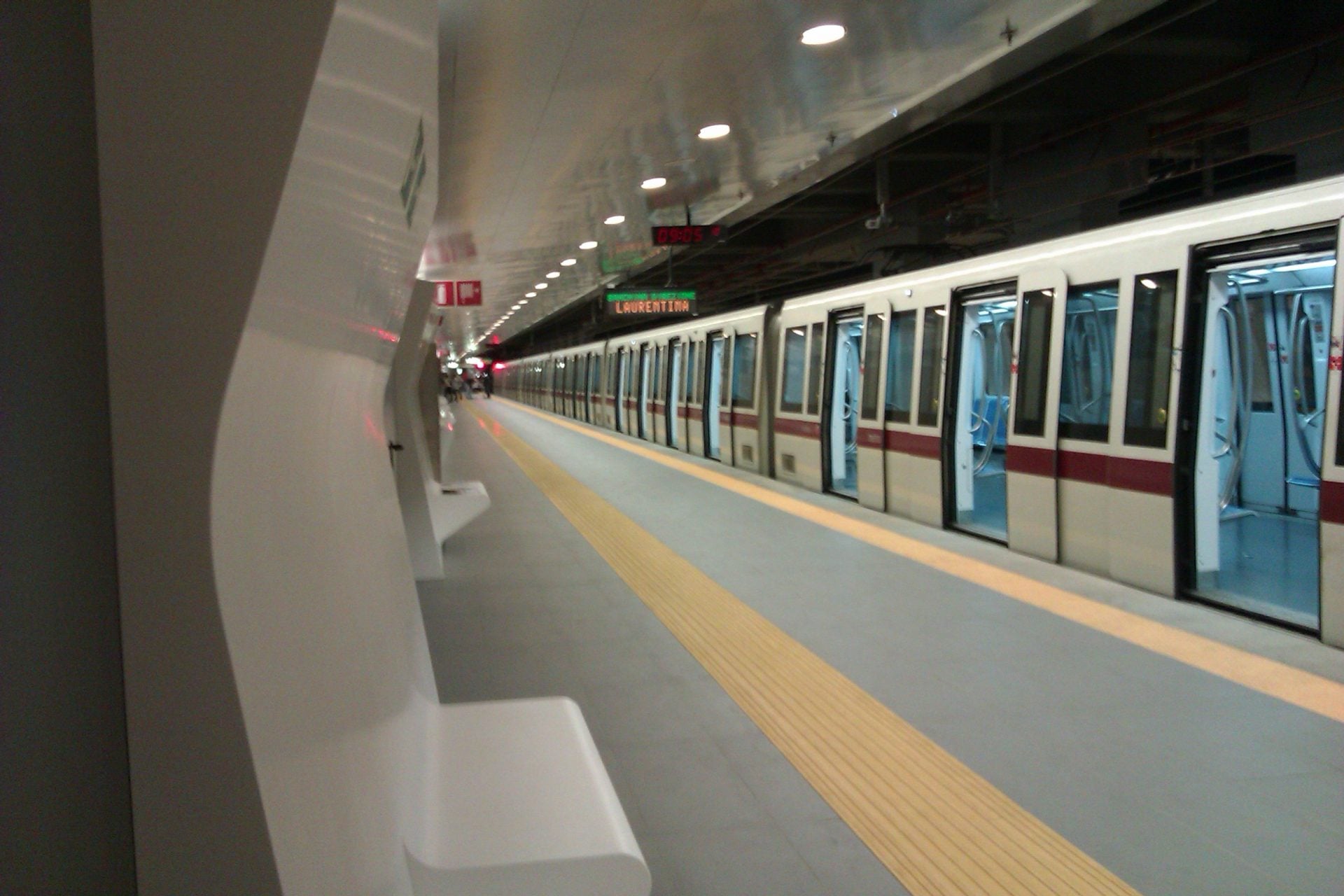
Rome only has three metro lines, due to the perils of digging underground in a city built on top of ancient ruins. Still, Rome’s metro connects to many of the city’s main attractions, and it’s really useful for traveling longer distances quickly.
The three lines are A (orange), B (blue), and C (green), with lines A and B being the most useful for visitors. Line A has stops near the Vatican, Spanish Steps, Trevi Fountain, Piazza della Repubblica, Piazza del Popolo, Borghese Gardens, and Vittorio Emanuele monument, and line B has stops near the Colosseum, Imperial Forum, Monti neighborhood, and Circus Maximus. Both lines A and B serve Termini train station.
The Rome metro system is a cheap and efficient way to get from A to B. Photo credit: ATAC
Buses: Best for Areas the Metro Doesn’t Cover
There’s a dense network of over 350 bus lines serving the city center, and these are especially useful for getting to places the metro can’t reach, including the Pantheon, Piazza Navona, Campo de’ Fiori, and Trastevere and Testaccio neighborhoods.
At stops that serve more than one bus line, check the sign on the front of each bus to make sure you’re getting the right one. Once you see your bus, wave your hand to make sure the driver knows to pick you up.
Insider tip: If a bus is already full and no one is disembarking at your stop, the driver will likely drive right by, even if you’re indicating that you want to get on. Annoying, but a normal cultural convention in Rome.
Buses won’t stop unless someone on board requests a stop or someone is waiting for a bus, so you need to pay attention to where you are and press one of the red “STOP” buttons before the stop you need.
Unlike metro and tram lines, buses can (and do) get stuck in Roman traffic. As a result, they are often running behind schedule, especially during weekday rush hours. Plan accordingly.
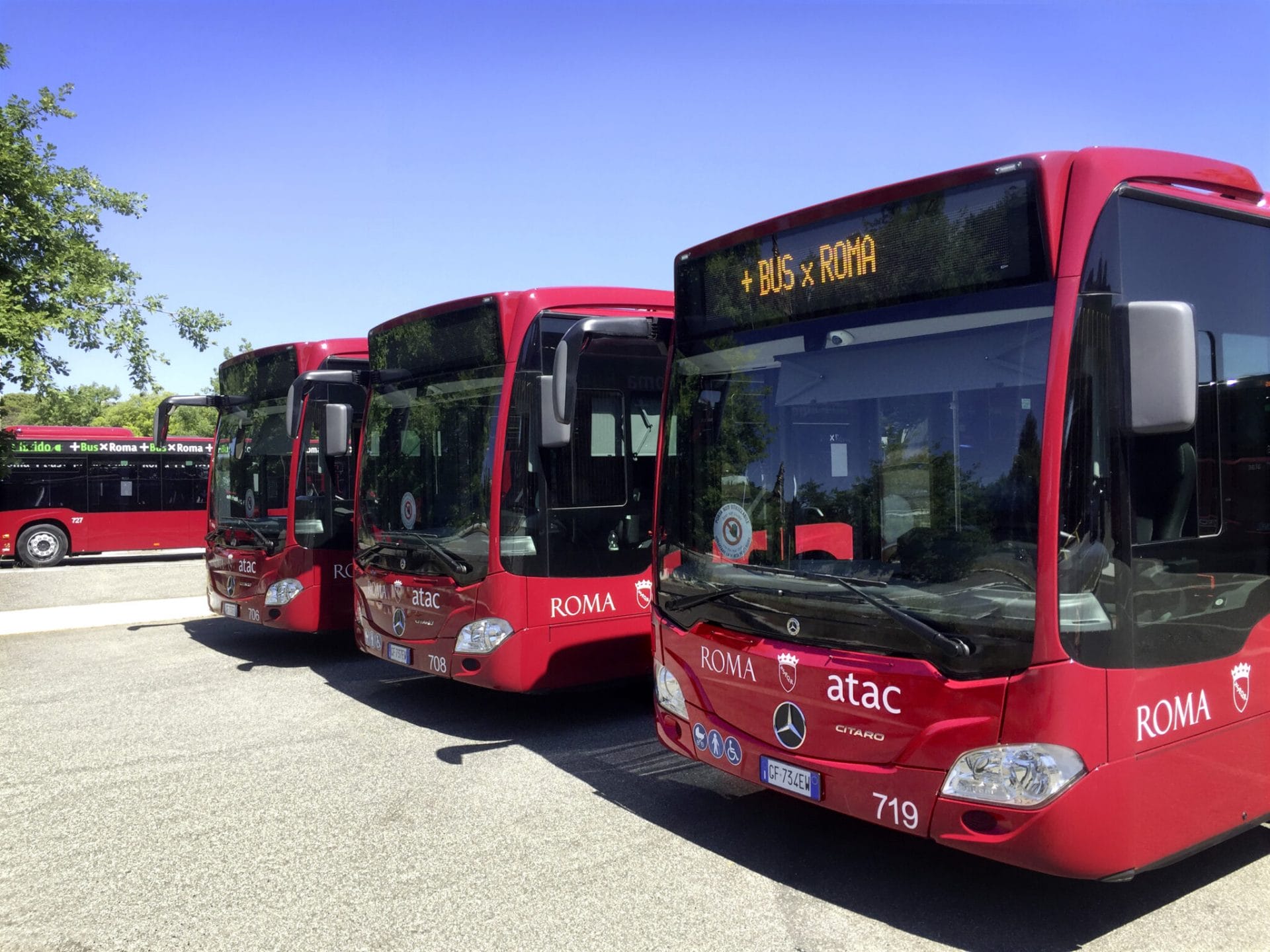
The buses in Roma are an effective way of getting around the city, for locals and tourists. Photo credit: ATAC
Trams: Best for the Trastevere Neighborhood
Rome has several tram lines, but visitors generally only need one or two. The most useful is line 8, which connects Piazza Venezia to the Trastevere neighborhood, but other lines stop near the Vatican, Colosseum, and Termini train station.
Tram stops look just like bus stops, but they’re easier to see thanks to the tracks on the street. You don’t need to hail a tram like you do a bus, as trams stop at each point along their routes. Stops are not announced on the trams, however, so you’ll have to pay attention to signs or a mobile navigation app.
Insider tip: Buses and trams that are popular with tourists can also be popular with pickpockets, especially when they’re crowded, so keep an eye on your bags and don’t keep your wallet or phone in your back pocket.
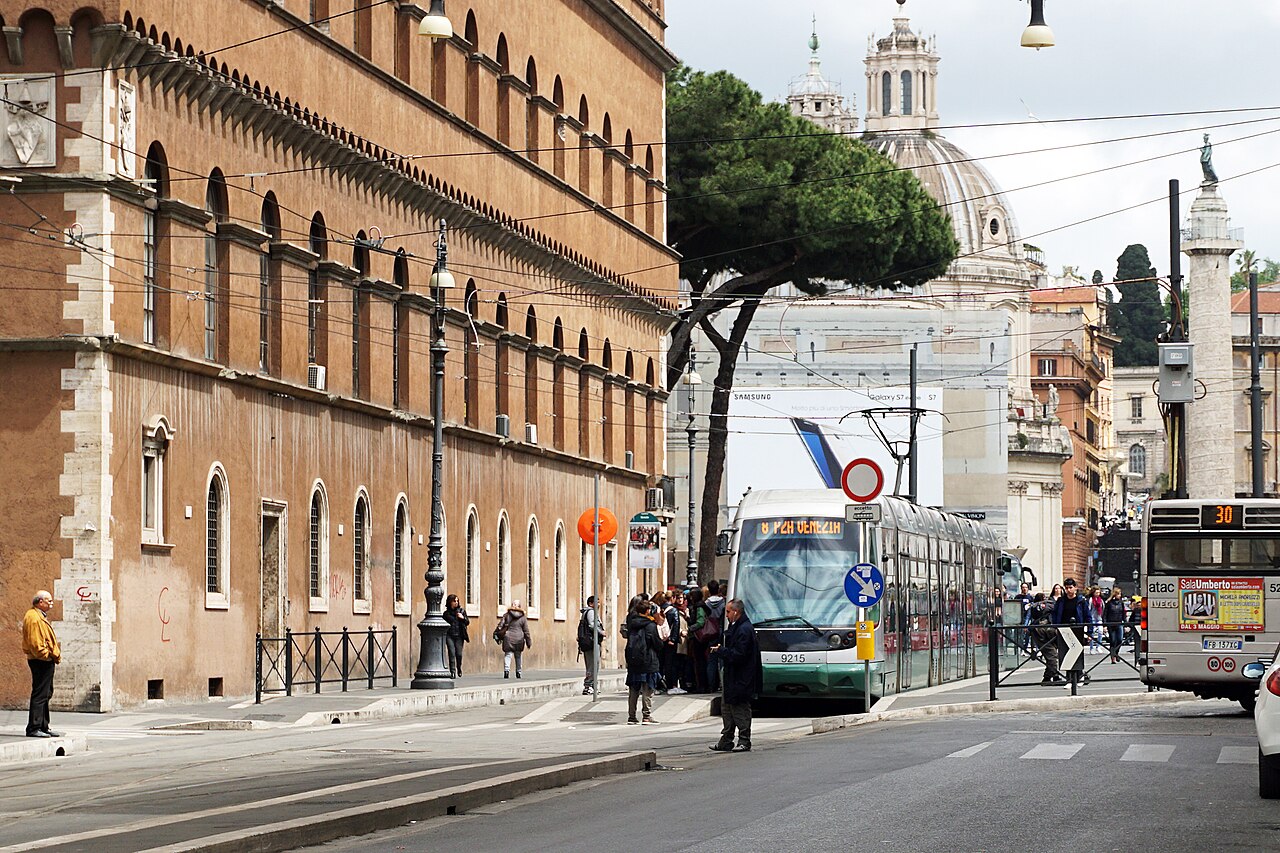
Trams near Piazza Venezia, a great choice for locals and tourists. Photo Credit: Mariordo (Mario Roberto Durán Ortiz)
Rome’s Public Transport Tickets
Types of Tickets and Passes
There are a couple of ticket options for public transit in Rome. You can either get individual timed tickets, or you can buy a pass that’s valid for a certain number of days. Ticket prices are listed on the ATAC website, and children aged 10 and under ride free when they’re with an adult who has a valid ticket.
Best for shorter visits that only require a few transit trips:
- A single timed ticket, called “BIT,” is valid for 100 minutes upon validation.
- A card with multiple timed tickets on it, called “Multi-BIT,” with 2, 3, 5, or 10 timed tickets. Each ticket is valid for 100 minutes.
Best for longer visits with several transit trips per day:
- Passes are available in increments of 24, 48, and 72 hours, as well as one week (called “CIS”) or one month. The clock starts on each pass when you first validate it.
Might be worthwhile for longer visits with several transit trips per day and itineraries that include the attractions on the pass:
- The RomaPass combines public transportation with free entry to some museums and attractions in the city and reduced entry fees at others. They’re available in increments of 48 and 72 hours, and grant you one or two free museum entries, respectively.

Guided tours are a great way to see the city, and move between attractions, without having to worry about the logistics
Insider tip: Even though a RomaPass includes free or reduced ticket prices to some sights around the city, it’s not necessarily the best option. Many guided Rome tours include both the admission to attractions AND skip-the-line access that saves you precious time, so a regular transportation ticket card or pass plus a special access tour may make more sense.
As mentioned, ATAC operates the metro, buses, and trams, so the same tickets are valid on all three. You can switch from the metro to a tram, for instance, without needing a second ticket. The exception to this integrated ticket system is that the “BIT” single timed ticket can only be used for one metro trip. You can change lines in a station on one ticket if you don’t exit through the turnstiles, but once you go through those, you need another ticket to start another metro trip.

When in doubt, you can always get tickets from a tobacconist shop. Photo credit: Helge Thomas
Where to Buy Transport Tickets and Passes in Rome
The most common ways to buy transit tickets used to be at news stands, the little convenience shops known as “tabacchi,” or ticket machines in metro stations. You can still get paper tickets at all of these places, but to be honest, nowadays most people use their smartphones or smartwatches instead.
- Tap&Go: Onboard buses and trams and in metro stations where you see the WiFi symbol, you can simply tap your device to the validator to automatically pay for your ticket with the credit or debit card you have saved in your digital wallet.
- Official Mobile App: ATAC released a bespoke mobile app at the end of 2025, ATAC Roma, where you can buy or add to digital tickets and passes. It also has a route planner, transit timetables, and real-time arrival updates for buses, trams, and metro trains.
- Partner Mobile Apps: Several apps work in partnership with ATAC, allowing you to buy (or add to) Multi-BIT tickets and some passes. The most popular one is Moovit.
ATAC has its own route planner website, and both the ATAC Roma and Moovit apps mentioned above let you plan a trip, buy tickets and passes, and see real-time arrival updates.
Important things to keep in mind:
- Paper tickets and cards can be purchased from machines in metro stations, but not on board metro trains. You can’t get tickets on buses and trams, either, and you need to buy tickets beforehand, use the Tap&Go system, or download one of the apps.
- Each traveler must have their own ticket, whether that’s paper tickets for every rider or separate devices for digital tickets.
If you already have a Multi-BIT card or a pass, you can add tickets or time to the card via the myAtac section on the official website.
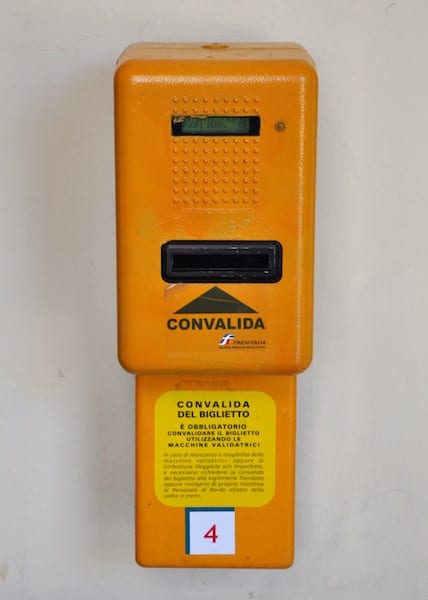
Don´t forget you need to validate your tickets too!
Don’t Forget to Validate Your Ticket!
Every ticket and pass must be validated before you begin a trip, either at a machine in a metro station or on board a bus or tram, purchasing a ticket or pass is not sufficient. Failure to validate a ticket when getting around Rome on public transport results in a fine.
You have to use your ticket, pass, or ticket app just to get onto the metro train platforms, which automatically validates your ticket. On buses and trams, however, you need to validate tickets upon boarding.
- For paper tickets, look for the (usually) yellow machines attached to posts near the doors, and insert the ticket into the slot.
- For digital tickets, tap your device on the validation screen of similar machines near the doors, which usually have instructions in multiple languages.

The Eternal City is vast, and public transport really helps you to get around cheaply and easily
FAQs – Getting Around Rome on Public Transport
What’s the best way to get around Rome?
When you’re trying to get from one part of the city to another, public transportation is the way to go. When you’re visiting several attractions in one neighborhood, walking is the best option.
What are the public transport options in Rome?
Getting around Rome on public transport is easy and affordable. Rome has three metro lines, several tram lines, and an intricate web of bus lines covering most of the neighborhoods and attractions visitors want to see. All public transit methods share the same tickets as they are all centrally operated by ATAC public transport agency.
Where can you buy tickets for public transportation in Rome?
You can get old-school paper tickets from local news stands and tabacchi, or the machines at metro station entrances and some larger bus stops. You can also use one of several mobile apps, or the credit or debit card stored on your device, by tapping it on a validation screen on metro turnstiles and on board buses and trams.
Do public transit tickets work on airport connection trains in Rome?
No, the trains that run between Rome’s airports and the city’s train stations are not included in the ticketing system for public transportation in Rome, you need to purchase specific tickets to travel between the aiport and the city
Are “hop-on hop-off” buses part of the public transit system in Rome?
You need to buy separate tickets for the sightseeing “hop-on hop-off” buses in Rome.

See the highlights of Rome with an expert guide, so you dont need to think about how to get to each place, it is all planned for you
Want to see the highlights of Rome without worrying about the logistics?
If you’d rather explore Rome with an expert guide, our highlights of Rome walking tour brings together some of the city’s most important sights, including the Colosseum, Pantheon and Trevi Fountain. It’s a great way to get your bearings, learn the stories behind the monuments, and make the most of your time in the Eternal City.
See Rome’s greatest hits, with a local expert leading the way.

Book a Tour

Pristine Sistine - The Chapel at its Best
€89

1794 reviews

Premium Colosseum Tour with Roman Forum Palatine Hill
€56
850 reviews

Pasta-Making Class: Cook, Dine Drink Wine with a Local Chef
€64
121 reviews

Crypts, Bones Catacombs: Underground Tour of Rome
€69
401 reviews

VIP Doge's Palace Secret Passages Tour
€79
18 reviews

Legendary Venice: St. Mark's Basilica, Terrace Doge's Palace
€69
286 reviews
Follow us
Stay up to date with travel tips, local insights and all things Italy on our social channels!


Subscribe to our Newsletter
Get curated Italy travel tips delivered to your inbox!

